
Which Ventilation Systems for Indoor Air Quality?

Updated: Aug 26

Ventilation Systems for Indoor Air Quality
Indoor air quality is becoming an increasingly important topic for homeowners, particularly in modern airtight properties.
We often focus on heating systems and insulation when thinking about comfort. However, the air we breathe inside our homes has a direct impact on condensation levels, mould risk, respiratory health and overall wellbeing.
Modern homes are built to higher levels of airtightness in order to meet energy efficiency standards. While this improves thermal performance, it also means moisture and pollutants can become trapped inside if ventilation is inadequate.
Understanding which ventilation systems improve indoor air quality can help you make informed decisions about your home.
Why Ventilation Matters for Health
Everyday activities such as cooking, showering, drying clothes indoors and even breathing release moisture and pollutants into the air.
Without adequate ventilation, this can lead to increased humidity, surface condensation and mould growth.
The UK Health Security Agency has published specific guidance linking damp and mould exposure to respiratory illness and wider health impacts (UKHSA, Damp and mould: understanding and addressing the health risks).
Effective ventilation removes stale, moisture-laden air and, in some systems, replaces it with filtered fresh air.
Mechanical Ventilation with Heat Recovery (MVHR)
Mechanical Ventilation with Heat Recovery systems are considered one of the most comprehensive solutions for improving indoor air quality in modern homes.

An MVHR system continuously extracts stale air from bathrooms and kitchens while supplying filtered fresh air into living areas and bedrooms. The heat from the outgoing air is recovered and transferred to the incoming air, reducing heat loss.
This approach provides whole-house air movement, continuous moisture control and filtered supply air. However, performance depends heavily on correct installation and commissioning. Poorly balanced airflow rates or damaged ductwork can significantly reduce effectiveness.
Positive Input Ventilation (PIV)
Positive Input Ventilation systems introduce filtered air into the dwelling, usually from a loft-mounted unit. This creates slight positive pressure, encouraging moisture-laden air to exit through background ventilation points.
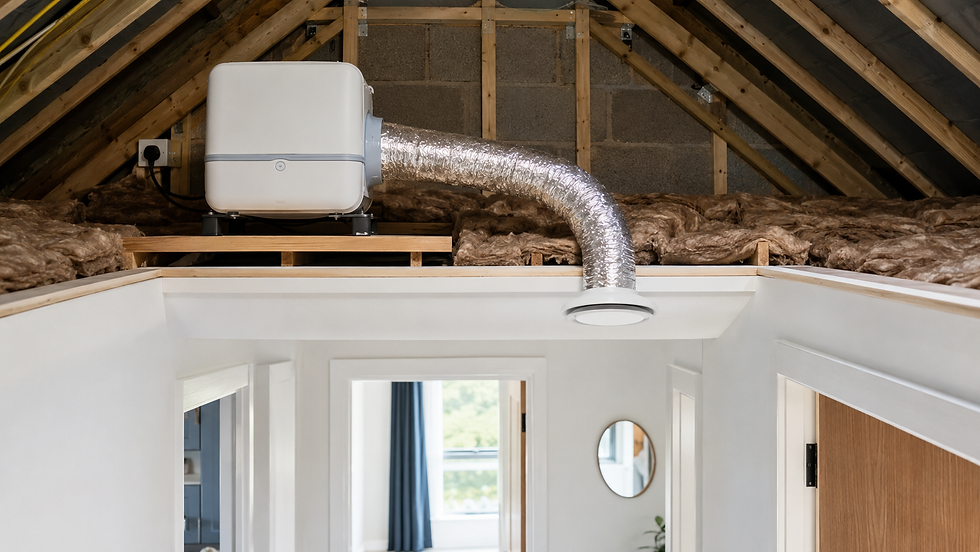
PIV systems are often used to help manage condensation and surface mould, particularly in properties where natural ventilation is limited.
While PIV improves air movement and can reduce condensation risk, it does not provide the same balanced supply-and-extract control as MVHR systems.
Mechanical Extract Ventilation (MEV)
Mechanical Extract Ventilation systems continuously extract air from wet rooms such as kitchens and bathrooms via a central fan unit.
MEV systems improve humidity control and increase air change rates in moisture-producing rooms.

Unlike MVHR, MEV relies on background ventilators such as trickle vents to allow fresh air to enter the dwelling.
Intermittent Extract Fans
Intermittent extract fans are commonly installed in moisture-producing rooms such as kitchens, bathrooms, shower rooms and utility rooms. Unlike continuous ventilation systems, they operate only when activated, usually by a light switch, pull cord, timer, occupancy sensor or humidity control, to remove moist or stale air directly to the outside.

These fans provide a simple and effective form of local ventilation. However, their performance depends on correct installation, adequate airflow, suitable overrun times and regular use by the occupants. Dirty fans, restricted ductwork, closed background ventilators or units that do not meet the required extraction rates can reduce their effectiveness and contribute to condensation and mould.
Which System Is Best for Health?
For overall indoor air quality, MVHR systems are generally thought to provide the highest level of controlled, filtered air throughout the home, particularly in new build properties constructed to high airtightness standards.
However, the most important factor is not just the type of system specified, but whether it has been installed, commissioned and maintained correctly.
In many cases, condensation and mould issues arise not because the wrong system was chosen, but because ducting has been poorly installed, airflow rates have not been balanced or extract terminals have not been correctly adjusted.
Ventilation systems must operate in accordance with Building Regulations and recognised technical guidance to deliver the intended health benefits.
Ventilation in New Build Homes
New build properties are required to comply with Approved Document F of the Building Regulations.
However, regulatory compliance does not automatically guarantee optimal performance in real-world conditions.
In new homes, ventilation systems may underperform for several practical reasons:
➡️ Ducting can become crushed or kinked within loft spaces during installation or by follow-on trades.
➡️ Flexible duct runs may be excessively long, poorly supported or loosely connected, reducing airflow efficiency.
➡️ Extract valves may not have been correctly balanced at commissioning stage.
➡️ Units may be left on default settings rather than adjusted to the specific property layout.
➡️ In some cases, background ventilators such as trickle vents are closed by occupants who are unaware of their role in maintaining airflow.
➡️ There are also occasions where systems have technically been installed to achieve sign-off but have not been fine-tuned to account for real occupancy patterns, furniture layout or how the home is actually used.
Independent ventilation assessment, including airflow testing and installation checks, can confirm whether a system is operating as designed and whether airflow rates meet regulatory standards.
Healthy homes are not just about insulation and energy efficiency. They depend on balanced air movement, controlled humidity and effective moisture management.
If you have concerns about how well your home is ventilated, whether your existing system is performing correctly, or you are experiencing condensation, mould or poor indoor air quality, contact us today for a FREE, NO OBLIGATION chat with a qualified surveyor.
How can we help?
Depending on the issue and what you need, there are a number of ways we can help you:
✅ Carry out a comprehensive inspection, assessment and health check of your existing ventilation system including identifying installation faults and defects, filter capability and establish airflow performance
✅ Assess other factors in the home that may be contributing to poor indoor air quality
✅ Investigate associated condensation, damp and mould problems
✅ Provide clear, practical recommendations to improve ventilation and indoor air quality
✅ Rectify faults or replace inadequate ventilation equipment where required
Get in touch today!


Comments